Pages

Tuesday, January 10, 2012

My Mouth is a Volcano!

My Mouth Is a Volcano (Children's/Life Skills)

I'm already writing about another Julia Cook book.  I just can't get enough!  This time I used the book My Mouth is a Volcano in 2nd grade.  This book is about a boy named Louis who has a big problem with "erupting" (interrupting).  His "important words slide down from his head onto his tongue.  His tummy starts to rumble, and then it starts to grumble.  His words begin to wiggle, and then they do the jiggle.  His tongue pushes all of his important words into his teeth and his volcano erupts!"  This  a cute story that children really enjoy.  Toward the end, Louis's mom teaches him a technique to keep him from interrupting.  I have used this book in classroom guidance, small groups, and individual counseling!  Anyone can use a reminder...


There is also an accompanying activity book called My Mouth Is a Volcano Activity and Idea Book. In the book, there is a project called "Button Up"  I tried this with my students this year and it was a success!  Each student is given a button and an index card.  On one side, they color their card green and write "Speak with good purpose" and on the other side, they color the card red and glue their button.  Beside the button they draw an up arrow in black.  The card is taped to their desk (button side up).  The teacher can use the card during instruction.  When it is the teacher's turn to talk, she tells students to flip their card to the button side (to remind them to button up!) and when it is time for student talk, they are asked to flip their cards to the green side.  I love this activity because I think its a great way to extend the lesson into everyday learning.  I'm a fan of anything that serves as a visual reminder!  So far, the teachers seem to like the idea and are using it. 


What types of visual reminders do you use for classroom guidance?

Friday, January 6, 2012

Bully B.E.A.N.S.

First of all, let me state that I LOVE all of Julia Cook's books.  Her books have a very clever way of discussing issues.  Not to mention, they have accompanying activity books (purchased seperately) so planning is super easy!  I'm sure I will be writing several posts about her books.  With that said, my absolute favorite is Bully B.E.A.N.S.  Whenever I introduce this book to a class, they all say "What?!" A lot of them think I'm going to teach them how to be bullies.  In the book, the reader meets Bobette, the bully.  I always point out how the illustrator draws Bobbette so that she looks bigger than the rest of the kids.  We talk about why he must have done that.  We come to the conclusion that the author wants to show us that she has the power.  The kids (the bystanders) in the book learn that they must find the confidence inside themselves to stand up to the bully.  As a reminder, one girls mom gives her bully beans.  She tells her they are magical beans that help her stand up to the bully.  They finally figure out that the beans are just regular jelly beans, but just serve as a reminder of what they already can do. 

This book has promoted some awesome discussions in the classrooms I use it in.  Kids just open up and talk about the characters and immediately start making connections to real life.  We focus on the power of the bully vs. the power of the bystanders.  Then we do an activity from the Bully B.E.A.N.S. Activity and Idea Book to show the importance of the bystander.  The bystanders can take away the power of the bully when they work together.  In the activity book, there is an activity where you use a blanket and have students demonstrate this power struggle.  You label one student as the bully, one as the victim, and 3 as the bystanders.  They line up like this: bully, bystanders, victim.  The bully starts out with the blanket and then slowly the bystanders start pullying the blanket (the power) back over to the victim.  We talk about how the power needs to be equally balanced.  It's a really powerful lesson!

I also keep a jar of "bully beans" on my desk as a reminder for students.  Sometimes students come in to see me and say they need a bully bean.  They are asked to tell me how they're going to use it before I give them one.  This is one that the kids still talk about!

Monday, January 2, 2012

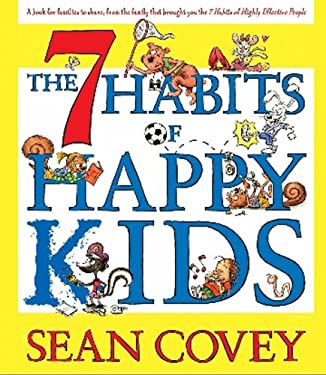
The 7 Habits of Happy Kids

As promised, I am posting more about the 7 habits.  This is a school wide initiative at my school that we have been doing for the past 3 years.  The 7 Habits of Happy Kids is written by Sean Covey, son of author Stephen Covey (The 7 Habits of Highly Effective People) and is aimed at elementary school age readers.  The book is composed of 7 short stories with a colorful crew of characters that students can relate with.  The stories teach the reader about each of the 7 habits by using nonfiction characters.  We started our initiative by beginning a Synergy Team.  This team was composed of several teachers and other certified staff at the school who would pilot the program.  These teachers were asked to cover the first 4 habits in their classroom.  Read the story, teach the skill, practice the skill.  It spread like wild fire!  Now, not only have we adopted all 7 habits in EVERY classroom, but our principal has made a block of time in our schedule daily for prosocial skills.  We call it Wildcat Team Time (WTT for short) and it lasts 20 minutes at the beginning of each day.  Teachers use the 7 habits along with other resources  to teach children about these skills that are so important to becoming leaders.  (That's our focus here...we're leaders and learners!)  The kids love the books, use the language, and refer to the skills on a daily basis.  It's amazing to see! 

The 7 Habits are:

Habit 1:  Be Proactive
Habit 2: Begin with the End in Mind
Habit 3: Put First Things First
Habit 4: Think Win-Win
Habit 5: Seek First to Understand, Then to be Understood
Habit 6: Synergize
Habit 7: Sharpen the Saw

Not only do our students succeed socially using these skills, but academically as well.  Teaching them to leaders has helped to teach them to take ownership for their learning and to be self-assessing.  After the initial success of the 7 habits in our school, we decided to give the parents an opportunity to learn more.  The Synergy Team hosted a parent night called "Growing Leaders With the 7 Habits."  After the information session, parents were given the opportunity to attend a 7 night workshop focusing on how to implement the 7 habits at home, hosted by yours truly!  I had so much fun discussing how these skills can be implemented in the home with several parents.  In the future, I'll have to rethink the time/dates because there weren't as many parents in attendance as we'd hoped.  I wish I had time to list all of the amazing things our teachers have done with the habits but I'd be sitting here all day!  A great resource to check out on the 7 habits is http://www.theleaderinme.org/

How have you used the 7 habits?  What lessons have you implemented using the habits? 

Tuesday, December 20, 2011

Happy Holiday Break


As we are winding down before Christmas break, I'm thinking about how I will spend my time while I'm not in school.  Of course, I will fill my time with family, my dog, and REST! But I won't know what to think without my busy schedule.  I'm sure I will be already planning out ideas for when we return, but I think it's important to remember Habit # 7 (from Sean Covey's 7 Habits for Happy Kids): Sharpen the Saw.  (I will be posting more about the 7 habits later).  Hiking with my dog is by far the best way for me to stay sharp!  It always seems like I am more inspired and able to serve my students after a restful break.  So...here's wishing everyone a restful break and a Merry Christmas!

How do you "sharpen the saw"?

My guy, Deakon! My dog, Deakon

Monday, December 12, 2011

Dianne Senn

One of my most recent purchases is Small Group Counseling for Children: Grades 2-5.  I really enjoy this book because it has everything you need to run small groups.  How to get started, planning, needs assessments, and lesson plans. This is a great addition to my collection.


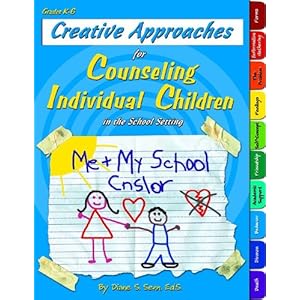
Another Dianne Senn gem is Creative Approaches for Counseling Individual Children.  This great book includes sample forms, information gathering tools, tips for identifying the problem, as well as a variety of different topics and ideas for use in individual counseling sessions.  I've used some of the ideas for small groups as well.  There's even a section on behavior support. 


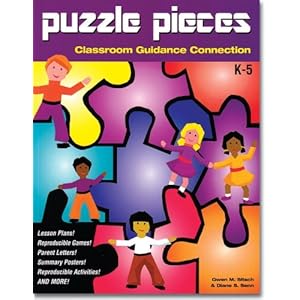
Lastly, for classroom guidance lessons, I've been using Puzzle Pieces: Classroom Guidance Connection ever since my internship!  I still use some of the same lessons.  This book has a collection of lesson plans on almost any topic you can think of for all grades K-5.  This book is one I know I can always turn to when planning classroom lessons.


What other Dianne Senn resources have you used??  I'd love to hear!

Thursday, December 8, 2011

Stop, Think, Do!

The steps for self control.  I teach the "stoplight method" in individual, small groups, and sometimes in classroom guidance.  It's an easy way for kids to visualize their thought processes.  I first learned about this on the yahoo elementary school counselors listserve, and I've tweaked it for my kiddos.  I start by asking them what happens when mom or dad is driving down the road and they come to a red light?  They all yell out "stop!" We then talk about the other colors...slow down, and go.  I tell them that the traffic light "controls" the drivers on the road to keep everyone safe.  We talk about what would happen if people ignored the traffic lights.  They all comment "they would wreck."   I then explain that this is the stoplight for their brain!  It helps them control their decisions and also helps prevent "wrecks" from happening in their life.  Sometimes when we "go" without thinking first, disaster strikes...we get in trouble, someone gets hurt, etc.  We then talk about each step....Red means "stop!", yellow means "slow down and think!" and green means "go!"  We have to think about our actions before we go!  I keep this posted right beside my board where I teach my groups for easy access.  I use this several times a week at least!  I even have a traffic light that lights up that I sometimes pull out.  This is a great technique to help with impulsivity and self control.

Thursday, December 1, 2011

Have You Filled a Bucket Today?

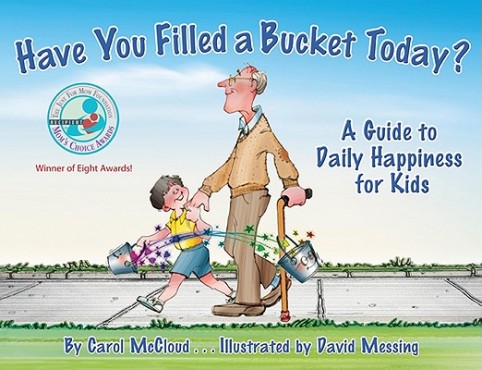
"Everyone has an invisible bucket.  You can't see it, but it's there"...This is one of my favorites!  Have You Filled a Bucket Today? by Carol McCloud teaches children the concept of words and actions and their impacts on people.  When someone does something kind for someone else, it "fills up their bucket" with good thoughts and feelings.  But when someone does something unkind to someone else, it "dips out of their bucket."  Students can easily make the connection to real life.  I use this book in so many ways!!  Last year, I read this story to all grade levels as part of introduction to the counselor lesson.  All year long, students made references to the book as they noticed other students behaviors.  That really filled my bucket!  This year, I regretfully did not use the book with all grade levels, but I will definitely pick it back up again next year!  Not only does this book apply to classroom guidance lessons, but also in small groups or individual counseling sessions.  I use this book during my initial sessions in small groups (particularly in self-esteem, in-control, and anger management groups).  The students love it.  We then practice filling up someone's bucket.  Definitely one to add to your collection!

Below is my "paper" bucket in my room.  The flowers have bucket-fillers from my self esteem/friendship groups.