In response to a comment posted by a graduate student, I'd like to share my daily schedule. Oh wait, I don't have a daily schedule (kind of)! As the only school counselor at my school of 500, I present classroom guidance once a month to each class, so I prepare a monthly calendar for guidance lessons. I also start new groups each quarter. The rest of my time is filled with individual counseling, planning, phone calls, conferences, touching base with students/teachers, and whatever else comes my way. Just to give you a picture, I decided to provide you with my schedule for 2 different days (since every day is different!) I usually make my schedule as I go. Guidance and groups are already added in, and as I get referrals, I fill my schedule for students and other things. Students give me their referrals (see my post Need to See the Counselor) and I plan according to need. I like to have it all planned out for the day (which I keep track of using google calendar). We operate on a block schedule, so there are only certain times I am allowed to pull kids to work with them (usually during their intervention/enrichment block). I try to stick to my schedule, but of course, things come up!
Schedule for Thursday, April 26:
7:20-7:40 Duty in the gym (we have walking club for early arrivals)
7:40-8:00 Prepare for my guidance lesson, hand out appointment passes
8:00-8:30 3rd grade guidance lesson on career pathways
8:30-9:00 Individual counseling with a 4th grader
9:00-9:30 Individual counseling with another 4th grader
9:30-10:30 Unscheduled time--Planning, following up with phone calls, updating my notes, working on Tier paperwork, responding to anything that comes up
10:30-11:00 Individual counseling with 3rd grader
11:00-11:30 Individual counseling with another 3rd grader
11:35-12:05 3rd grade test anxiety group
12:05-1:00 Lunch (I always make a point to schedule this, or else I won't eat), meeting with teachers, following up with students as things come up
1:00-1:30 5th grade test anxiety group
1:40 - 2:10 4th grade guidance lesson on stress
2:10-2:30 Follow up phone calls, touch base with teachers, update my notes, and check in on students
2:30-3:00 Individual counseling with 1st grader
3:00-3:15 Kids dismiss
3:15-4:15 Faculty Meeting
Schedule for Friday, April 27
7:30-8:30 Planning for day, preparing for 5th grade guidance, hand out my appointment passes
8:35-9:35 5th grade guidance lesson on test anxiety/strategies (5th grade classes rotate, so I presented to 2 classes in this time)
9:35-10:05 Checked in with teachers, made some phone calls, prepared for students
10:05-10:35 5th grade guidance lesson on test anxiety/strategies (the last rotation)
10:35-11:05 Individual counseling on divorce with a 3rd grader
11:05-11:35 Individual counseling with another 3rd grader
11:45-12:15 3rd grade test anxiety group
12:15-12:30 Checked in with a student briefly...will make an appointment with her next week, but gave her some strategies to try in the mean time.
12:30-1:00 Lunch, planning, responsive services, updating notes, added above student to my calendar
1:00-1:30 Individual counseling with 5th grader
1:40-2:10 4th grade classroom guidance on stress
2:20-2:50 Social skills small group (1st grade)
3:00-3:30 (or usually later...) Dismissal, planning for next week, following up with teachers, catching up on notes for the day, etc.

Friday, April 27, 2012

Thursday, April 26, 2012
Bugs In My Hair?!

Reasons I love it:
It takes away the stigma of lice
It debunks the myth that lice only like dirty hair
It helps children feel like they are not alone
It explains what lice are in a kid-friendly way
It covers all of the procedures for removing lice
I think this book will be great for individuals struggling with lice AND classroom guidance! My hope is that in reading this to a whole class, we can create some empathy and take away the stigma for good!
After all..
These things happen!
Monday, April 16, 2012
Taming the Test
 |
| Thanks to Allison from the Counseling Corner for the blank controller! |
Today we are back in school after a restful and relaxing SPRING BREAK! I put all of my school stuff aside and took a much needed break. Now that we're back, the focus is on getting prepared for end of grade testing! Yikes! Cue the scary music. In the past I have always done guidance lessons in 3-5 classes on stress and relaxation techniques. We talk about good stress (that motivates us to do our best) and bad stress (that keeps us from doing our best). This year, I've been asked to present small groups for third graders who have really been having a hard time with benchmarks this year. I was immediately excited to think of all of the cool ideas I've seen on other blogs, pintrest, and other sites on this topic. I decided to expand the offer to all grades 3-5 and the feedback was AMAZING! I am currently facilitating 6 groups on test anxiety, serving 22 students. I feel so motivated to help these kids learn techniques for reducing stress in testing situations. I started a few of the groups before spring break, and the feedback from students was great. I heard comments such as, "this will be really helpful," "I can't wait to tell my mom what I'm learning, she will be so excited;" and "I'm so happy to meet other kids who feel this way." I'm so happy that the kids are just as excited as I am. I will post more later on what we've done in the group, but here's some of the items on the agenda:
- Where I feel stress in my body, and how to relax my body
- Relaxation techniques and other ways to reduce stress
- Taking Back Control (this uses a game controller to teach strategies for test taking)
- Thinking positive thoughts
 |
| Where I feel stress in my body |
 |
| Strategies to relax my body |
And as I am posting about small groups, I thought I would share my group "Rules", or as I call them EXPECTATIONS...
- Be Here. This means I am an active member of this group.
- Be Safe. I know that what I say in here stays in here. I know that I have the right to pass if I don't want to share.
- Be Respectful. I will listen while others are sharing and use kind words.
- Be Confidential. I will respect my friends' privacy by not sharing what is said in group. I know that I can share my group experience with my family or teacher, but not my friend's experience.
Monday, April 2, 2012
My Anger Mask
This morning I was trying to plan something to work on with one of my regular students with anger issues when I decided to expand on a lesson I already teach in my anger management groups. This student has a lot going on at home and we've already been working on the windows activity, but I wanted to get to the root of his anger. We talked about the anger mask (the activity from Seeing Red: An Anger Management and Peacemaking Curriculum for Kids). I love this book for so many reasons! After showing him my anger mask (made out of a paper plate), we made a list of some "unpleasant feelings" on the board: discouraged, jealous, embarassed, hurt, scared, worried, etc. Next, I gave him his pre-prepared foldable in which to draw his anger mask on the front. I explained to him that sometimes when we're angry, we're actually feeling something else on the inside. I give him several examples, such as someone calling you a name....you may show your angry face, but actually you might be feeling hurt. After drawing his anger mask, we pick out some of the other unpleasant feelings that we may be actually feeling on the inside, and draw them inside the foldable. It ended up being a great visual (see mine below) and started some great conversations about some of the things causing this little guy to be angry. I've posted pictures of mine below, but didn't want to show his due to confidentiality, but it was awesome! I'll definitely be doing this activity again!


How do you "dig deeper" to figure out the root of a child's feelings?


How do you "dig deeper" to figure out the root of a child's feelings?
Thursday, March 22, 2012
Windows
I was recently looking for information gathering ideas for meeting with individual students. I have my emotions tree, I have my feelings charts, but I wanted something more. Something to really let me peer into what's going on inside these kiddos. As usual, I consulted my copy of Creative Approaches for Counseling Individual Children in the School Setting by Diane S. Senn. (I've posted about this book before). The activity I was drawn to was entitled Windows to Our World. I drew a window (complete with curtains) on my white board with panes so it's seperated in 4 sections. Next, I cut a piece of paper into 4 pieces and taped each piece on the board. I talk to students about what the purpose of a window is. They will say "to look outside" and I say, "what happens when you're outside and look inside a window?" and they will say "you see what's inside."

Explain to students that this is a window to our world. This is a chance to look inside your world at home, school, with friends, and yourself. I ask students which they would like to begin with, and then we pull down that piece of paper and they draw a picture of that aspect of their world. I've really enjoyed this activity because kids have really bought into it. Some of them even like to draw curtains on each of their pieces of paper, so it really looks like an outsider is looking in. This is a great way to learn more about what is really going on in a child's life and see their perception of it.
Wednesday, March 21, 2012
Personal Space Camp!
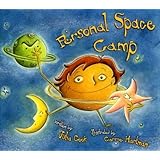 I've already posted about this amazing author before, but yet again, I'm already posting about another Julia Cook book! This book is called Personal Space Camp and it's a fun way to talk to kids about respecting others' space. In the story, we meet Luis again (same character from My Mouth is a Volcano). He thinks he is a space expert! "Zoom Zoom, Zip Zip, Buzz the planets, Tickle the sun, Back to Earth, Now that was fun!!" Luis is told by his teachers that he has a problem with personal space, which is very confusing to Luis since he thinks he is a space expert! Luis attends Personal Space Camp in the principal's office where he finally learns the difference between outer space and personal space.
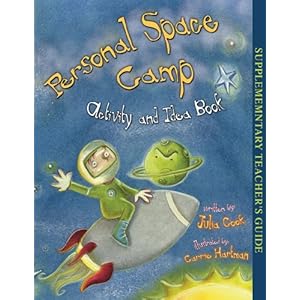
 What could make this any better? Of course! There is the activity & guide book which is also available for purchase! Oh Julia, you make life so easy for us! There are all kinds of activites in the book, such as clumping all of the desks together (to show how impossible it would be for us to work this way), creating personal space place mats, a space freeze game, and many more! I feel like an advertisemet, but I just can't say enough good things for these books. Enjoy, Personal Space campers!
Wednesday, March 14, 2012
What's the best part of an M&M?
The best part of an M&M is the inside! I've done this lesson for the past 4 years and it is one of my favorite ones to present! This lesson came from Puzzle Pieces, a great classroom guidance resource by Dianne Senn and Gwen M. Sitsch, and is an awesome way to make kids understand the importance of not judging our friends by the way they look.
Preparation:
Showtime!
Introduce the gifts to the class and ask, "If it were your birthday and you could pick whichever gift you wanted, which would you want and why?"
Preparation:
Prepare 2 shoe boxes (same size)...one with pretty birthday wrapping paper and a nice red ribbon, and the other one with newspaper (with tears) and twine.
Inside the box with the pretty wrapping, put rocks
Inside the box with the newspaper, put M&Ms.
 |
| which gift would you pick? |
Introduce the gifts to the class and ask, "If it were your birthday and you could pick whichever gift you wanted, which would you want and why?"
Listen to the students share which one they would pick and why. You will see that most kids will pick the fancy gift. I really amp this up by trying to get them to guess what's inside!
After they have guessed, open up the box and show them the rocks.
Now ask how many changed their mind. (All of them will raise their hands)
Now open the box wrapped in torn newspaper and show them the M&Ms
Kids love this lesson and talk about it for a long time! I recently saw in the latest issue of Teaching Tolerance that someone used tootsie pops to teach this same lesson. Love it!
After they have guessed, open up the box and show them the rocks.
Now ask how many changed their mind. (All of them will raise their hands)
Now open the box wrapped in torn newspaper and show them the M&Ms
Conclude with the class that although the birthday box was wrapped nicely, it wasn't very nice on the inside, but the newspaper-wrapped box was sweet on the inside. Have a discussion with the class about how this relates to choosing our friends. Tell them, even though someone is really nice looking on the outside, maybe has the most stylish clothes, it doesn't mean they're a nice person on the inside. It doesn't matter what color they are or what they look like. But we don't know, that's why we have to take the steps to get to know someone.
After the discussion, pass out M&Ms for everyone and ask them what is the best part of the M&M. They will all say "THE CHOCOLATE!!" Explain to them that the color of the M&M does not really matter. Demonstrate this by having a student come up in front of the class, close their eyes, and taste an M&M. They will try to guess what color it is. They will not be able to tell!
 |
| People are like M&Ms |
Explain to them that people are like M&Ms, it doesn't matter what we look like on the outside, it's what's on the inside that counts. We should choose our friends by the way they act and treat others, not by how they look.
Subscribe to:
Comments (Atom)